Recovery, community, and the purpose behind my work.
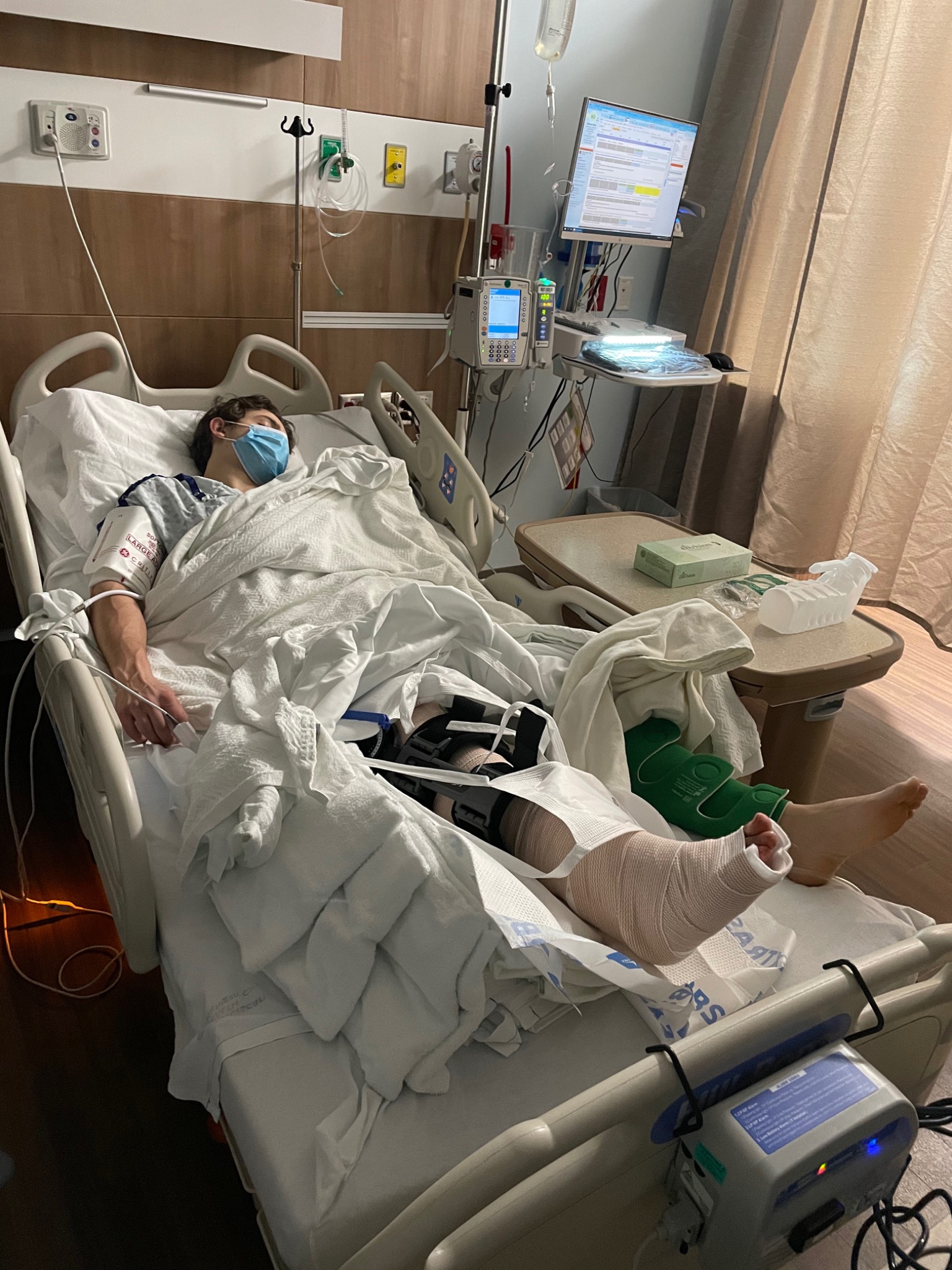
Recovering from my leg injury in 2021.
My Comeback Story
In January 2021, a sledding accident severely injured my right leg. Doctors weren’t sure whether I would walk again. Five surgeries and two years of rehabilitation followed, with progress measured one milestone at a time.
Doctors, nurses, and physical therapists helped me regain mobility. As a tissue donation recipient, I also benefited from someone’s decision to donate. I wanted to contribute in ways that could make a similar difference for others.
Recovery taught me to be patient, consistent, and willing to adjust when something wasn’t working. Those habits now shape how I approach engineering projects, research, and teamwork.
Turning Recovery into Action
As a tissue recipient, organ donation is personal to me. Someone else’s decision helped make my recovery possible, and I wanted more people to understand what that decision could mean. I worked with WLTL to build an organ donation education campaign, creating radio programming, educational materials, and opportunities for students to learn about registration.
That effort grew beyond my school. I raised $2,000 and partnered with the Illinois Secretary of State to bring the initiative to more than 50 schools. The campaign earned three national IBS award nominations, and a Secretary of State visit to Lyons Township helped bring the message directly to students. At Duke, I founded a SODA chapter to continue that work through peer education and donor registration.
Giving back also meant building community. I helped revive my high school’s Best Buddies chapter by recruiting members, introducing events, and improving the program’s structure. I continue that involvement through Best Buddies and Unified Special Olympics at Duke. Those friendships, along with mentoring students and listening to hospice patients, remind me that everyone has something to teach me.
Why I Chose Electrical & Computer Engineering
The people who helped me recover showed me how much a person’s work can change someone else’s life. I want to carry that purpose into engineering.
ECE gives me the tools to work across industries, combining electronics, sensing, programming, and data to solve problems that affect how people live and work.
At Helping Hand, I interviewed department leaders, translated operational needs into technical requirements, and presented recommendations to stakeholders. I cleaned historical data and built and refined data tools and workflows to support staff serving clients and families.
In my gyroscopic bowl project, I led a four-person team through mechanical design and prototyping to build a functional bowl for steadier food transport. My semiconductor research extends that curiosity to the fabrication processes behind electronic devices.
Recovery also shaped how I work: make steady progress, adjust when an approach falls short, and keep working through uncertainty. I bring that discipline to designing, coding, testing, and revising. My goal is to build technology that helps people, starting with a clear understanding of the problem and the people who experience it.
Launched an organ donation campaign after receiving a tissue transplant, raising $2,000 and designing and distributing thousands of bracelets and educational pamphlets.
Partnered with Illinois Secretary of State Alexi Giannoulias to expand the initiative to 50+ schools; recognized with an Illinois Certificate of Service.
Founded Duke’s SODA chapter and recruited 20 members for peer-to-peer education and donor registration.
The campaign received nominations and placements in multiple IBS award categories.
Undergraduate Research Assistant · December 2024 – May 2025
Segura Lab, Duke University
Investigated hydrogel-based post-stroke therapy through grid-walk testing across a 30-rat treated and untreated cohort.
Collected in vivo and ex vivo tissue samples from 15 rats while supporting tissue-regeneration experiments for two PhD candidates.
Presented findings at weekly lab meetings and to 20 attendees at a research showcase, developing skills in pipetting, data analysis, and regenerative-medicine research.
Seasonal Ultrasound Technology & Clinical Education Model · June 2023 – Present
Loyola Medicine
Aided 400+ medical students training for eye, ultrasound, and emergency medical examinations through a clinical education model role.
Completed 75+ hours observing Trauma/Emergency Medicine, including imaging systems, medical technology, and procedures.
Seeing medical imaging used in care strengthened my interest in how technology helps people. It gave me a view of engineering from the user’s side: the students and clinicians learning to work with the equipment.
The experience reinforced the value of clear communication, usable tools, and understanding the environment in which a technology will be used. I bring those perspectives to engineering, product, and consulting work.